I finished this piece of artwork this morning! I like to think of it as my version of "Fish Magic", after the painting of the same name by the artist Paul Klee (please see my previous post dated March 13, 2011). I created this digitally, using Blender, LuxRender, Painter, Photoshop and Illustrator.
I remember my family having neon tetras when I was a kid (what kid doesn't love neon tetras?). Also I think we had a red tailed shark (seen in the lower right). The large fish is a tiger barb, and the reclusive orange fish is a female swordtail. Something important must be happening beneath the waves, what with every fish gathering around the clock. :)
Another image that I have hanging in my bedroom, is a poster of Paul Klee's "The Tightrope Walker". The original is a lithograph, created in 1923, which hangs at the Scottish National Gallery of Modern Art, in Edinburgh, Scotland.
There's an enlargeable photograph of the Scottish National Gallery, at the Wikipedia website (per the link above). To me, the building looks like it was set on fire, and then dressed up with some banners and a manicured lawn, to spruce it up. It looks awful! But the art inside is surely priceless, so who cares what it looks like. Just another place that I have to make sure to visit one day. Anyway, I don't know squat about lithography (a type of printing process), but I can say that Paul Klee's use of it for "The Tightrope Walker" is evidence of his wide use of different media in creating his works. I wonder if the pinkish background (with the spotlights crisscrossing it) was watercolor on the paper, before the dark print was made.
Klee claimed that he enjoyed "taking a line for a walk" and indeed such artwork as "The Tightrope Walker" are among his most playful images (in a body of work known for its whimsy). He liked to create drawings in which a single line wanders around the paper, crossing over itself several times, and then he would shade along one side of the line, down the entire length. Because of curves in the line, sometimes the shading would be on the "inside" of the shape, and sometimes on the "outside". Several of these lines together would create a harmonious "polyphonic" drawing (a musical reference in which different elements combine to create a composition). He also might use just a few meandering lines to create a complicated subject, such as the city skyline seen in the painting "Threatening Snowstorm":
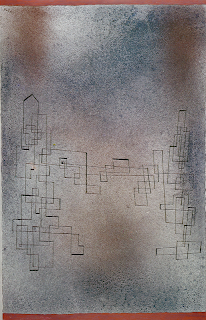
It's been reported that the artist Hedda Sterne has died at the age of 100 (coincidentally the same age as Dorothea Tanning, still living). Hedda was considered part of the Abstract Expressionists (although she said that she was uncommitted to any art group or label, and that she painted free of outside influence). Although I'm certain that I've encountered her paintings at the Museum of Modern Art in New York, I have not been much familiar at all with Sterne. Exploring her work online, I would say that she had a persistent type of inventiveness which we saw in the Expressionist Paul Klee. As I mentioned before about Klee, he had this remarkable ability to reinvent his artwork, while still retaining enough of his own identity so that his work is recognizable as belonging to him. To me, this helped make him a master artist. As I gain more familiarity with Sterne, I wonder if this same characteristic could seen in her work (my initial impression is that her styles do vary more widely than Klee's).
An article on Hedda Sterne's passing can be viewed here.
This is another painting that I always enjoy seeing when I'm at the Philadelphia Museum of Art (you can click on it for a bigger view):

The painting is "Fish Magic" by my favorite abstract Expressionist, Paul Klee. One thing that I like about Klee is that in spite of his knack for constant visual innovation, I almost always manage to recognize a painting as being done by him. To me this is something that makes abstract art so worthy of our admiration... the development of a style and a language through which an artist communicates. It's irresponsible to dismiss abstract art as being unskilled, as the art highlights capacities that are uniquely human... The ability to appreciate not just physical aspects of color, form, line, and texture, but also playfulness, humor, tragedy, and a limitless number of other moods and intangibles. Indeed, it is partly these ethereal qualities of humanity which have had some theoretical physicists declaring that science cannot explain everything (the limit of science being that everything we "know" is based on some other assumption being accepted as true) and even the Grand Unified Theory, if it's ever found, won't explain what love and hate are. (Or maybe the reason that we can't find this Theory of Everything is because western science has spent decades dismissing life as a meaningless accident in the universe, thus downplaying a significant part of what we know is reality, that being our thoughts and emotions). Anyway, let us not demand merely representational art (a common issue in today's digital art realm). We can demonstrate concepts beyond just technical competency. Abstract art reminds us of why we are different from inanimate objects and even intelligent animals. Color and line are amazing things in themselves, and we can appreciate them easily.
Klee was a master of working with different painting media. He often made considerable effort prepping a ground for his canvas, and in his "Fish Magic" painting, he actually cut out a rectangular piece of fabric and pasted it onto the main canvas (easily visible). In a book titled "Klee", Douglas Hall / Richard Verdi described the extra piece of canvas as a window of time, splitting the head of the red figure at the bottom of the painting. The little fellow is somber, looking inside the box, where the manmade clock is, but the face is happy which looks to the outside, where nature runs amok. I suppose that this suggests well the benefit of freeing ourselves from the self-inflicted, limited perceptions and attitudes, the desire to explain everything with logic and reason!


